



- With four cards, you try to hold as many cards as possible with no shared rank or suit.
- The hand with more such cards wins; if tied, the lower hand wins.
Base: 2-7 Triple Draw
Differences from 2-7 TD:
- Four cards. Draw 0 to 4
- First count the cards with no shared rank or suit: 4 (a badugi) > 3 (a tri) > 2 > 1
- With two of a suit, only the lower counts; with two of a rank, only one counts
- With the same count, compare from the highest card down; lower wins
- The A is lowest. There are no straights. The best hand is A-2-3-4 in four suits
Three draws, four betting rounds, blinds and Fixed limit are the same as 2-7 TD.
Example. The counted ranks are written from highest to lowest.
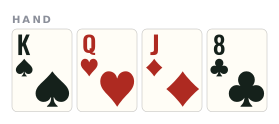
- X: K♠ Q♥ J♦ 8♣
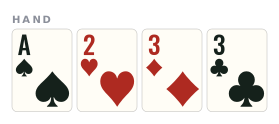
- Y: A♠ 2♥ 3♦ 3♣
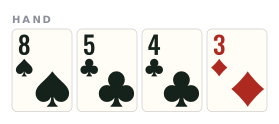
- Z: 8♠ 5♣ 4♣ 3♦
- Count the cards that play
- X: every rank and suit differs → four cards, a badugi (K-Q-J-8)
- Y: two 3s, so only one counts → three cards, a tri (3-2-A)
- Z: two ♣, so only the lower 4♣ counts → three cards, a tri (8-4-3)
- X has the most cards and wins. Even with a K, four cards beat three
- Y and Z both have three. The highest card is 3 for Y and 8 for Z. Y is lower, so Y ranks higher