



- There is no shared board: you make the best five of your own seven cards.
- There are no blinds; play starts with antes and a bring-in, and betting is Fixed limit.
Dealing:
| Street | Cards dealt | Unit |
|---|---|---|
| 3rd street | 2 down + 1 up (the door card, the first up card) | Small bet |
| 4th street | 1 up | Small bet |
| 5th, 6th street | 1 up each | Big bet |
| 7th street | 1 down | Big bet |
- A live table seats up to 8. No blinds; everyone pays an ante
- The button only marks where dealing starts. The cards decide who acts
- First to act on 3rd street: the lowest door card pays the bring-in (the A is high). Ties go by suit, ♣ < ♦ < ♥ < ♠, and the lower suit pays
- That player pays just the Bring-in (a small amount) or puts in a full small bet right away (Complete)
- Players after that, clockwise from the bring-in’s left: Fold / Call the bring-in / Complete. After a Complete: Fold / Call / Raise. A Complete doesn’t count as a raise, so three Raises can still follow it (cap)
- 4th street on: the strongest face-up board acts first. A pair beats high cards. On a tie, the player closest to the dealer’s left goes first. The order can change every street
- Fixed limit. On 4th street, if anyone shows a pair, the first bet may be a big bet (an open pair)
- At showdown, use any five of your seven
Example. A 6-handed table at 10/20, ante 1, bring-in 3. Door cards: 3♣, 3♠, 5♦, 9♣, Q♠, A♥.
- The lowest rank is 3. There are two: 3♣ and 3♠
- Same rank, so the suit decides. ♣ < ♦ < ♥ < ♠, so 3♣ is lower
- The 3♣ player pays the bring-in of 3. The pot is antes 1 × 6 = 6 plus 3, 9
Example. On 4th street one player shows 9♣ 9♦. Nobody else shows a pair.
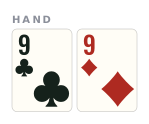
- A pair beats high cards, so this player acts first
- With a pair showing (an open pair), the player may bet either the small bet of 10 or the big bet of 20
Example. Same 10/20, bring-in 3. Facing the bring-in of 3, the next player chooses Fold, Call 3 or Complete 10. After Complete 10, the Raises go 20 → 30 → 40 and the betting is capped.
Note. At an 8-handed table with everyone still in on 7th street, 8 × 7 = 56 cards are needed, more than 52. When the deck has fewer cards than players left, one card goes face up in the middle as everyone’s seventh card (a community card). It can’t happen 6-handed.